


Views: 0 Author: Site Editor Publish Time: 2026-08-14 Origin: Site


The aerospace sector operates in a zero-margin-for-error environment. A single component failure can cause catastrophic consequences mid-flight. Manufacturers face immense pressure to deliver flawless parts repeatedly. Legacy manufacturing methods often struggle to meet these rigorous demands. Today, advanced Aerospace CNC machining serves as the primary driver for part consistency, weight reduction, and overall safety.
Successful aerospace production relies on much more than capable machinery alone. It demands stringent quality control, deep material expertise, and verifiable compliance. Sourcing precision parts requires a comprehensive approach to vendor evaluation. You must align engineering specifications precisely to manufacturing capabilities. This article explains how you can navigate these complex supply chain requirements effectively. We will explore specific machining technologies, material selection strategies, and risk mitigation tactics. You will learn actionable steps to evaluate partners and safeguard your production schedule.
Absolute Tolerances: Aerospace CNC machining routinely achieves tolerances as tight as ±0.0001 inches, which is non-negotiable for engine components and flight controls.
Material Expertise is Critical: Success requires proven competency in machining difficult, high-strength-to-weight metals like Titanium, Inconel, and aerospace-grade aluminum.
Compliance Over Cost: Vendor selection must prioritize AS9100D certification, ITAR compliance, and full end-to-end material traceability over baseline pricing.
Risk Mitigation: Transitioning from prototype to production carries supply chain risks; choosing a partner with scalable 5-axis capabilities mitigates lead-time bottlenecks.
Aerospace engineering stakes remain incredibly high across every project phase. Aircraft endure extreme temperature fluctuations during a standard flight cycle. Components face intense structural loads during takeoff and turbulence. Engineers also battle strict weight limitations to optimize fuel efficiency. These harsh realities leave absolutely no room for manufacturing deviations. Every single bracket, fastener, and turbine blade must perform perfectly.
Out-of-tolerance parts create severe operational and financial impacts. Even minor inaccuracies trigger massive assembly delays on the production floor. You might face disastrous FAA or EASA audit failures if non-compliant parts enter the supply chain. In worst-case scenarios, dimensionally flawed components lead to catastrophic system failures. Recalls and grounded fleets cost companies millions in revenue. Reworking defective batches consumes valuable time and degrades overall project profitability. Reliable precision becomes a mandatory survival metric for aerospace businesses.
Basic casting and manual milling fall terribly short in this environment. Casting often leaves internal voids or inconsistent structural properties. Manual milling introduces human error and lacks necessary repeatability. Modern aerospace programs require exact duplication across thousands of production cycles. Advanced CNC machining eliminates these inconsistencies entirely. Computer-controlled cutting tools follow precise digital paths without deviation. This technology guarantees uniform wall thicknesses and exact geometric profiles. It removes the guesswork from complex manufacturing runs.
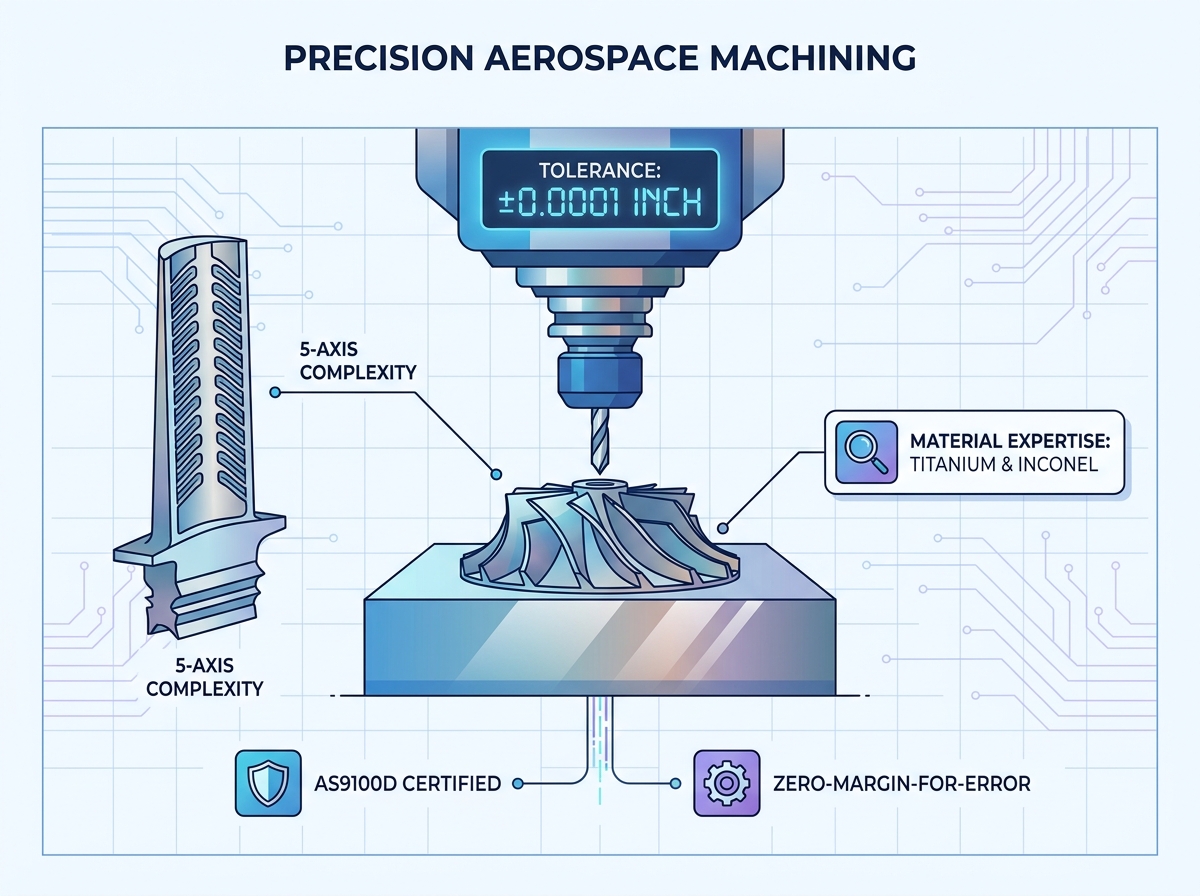
Aerospace components demand sophisticated equipment to achieve their required geometries. Simple three-axis setups cannot handle the organic shapes found in modern aircraft. Advanced machining centers provide the necessary dexterity and precision. We rely on several key technologies to meet strict aerospace standards.
Simultaneous 5-axis machining represents a massive leap in manufacturing capability. The cutting tool and the workpiece move simultaneously across five distinct axes. This allows the machine to reach complex angles in a single setup. It drastically reduces part handling between different operations. Less handling directly minimizes cumulative human error.
You need this technology to create complex geometries. Turbine blades feature contoured aerodynamic surfaces requiring continuous tool movement. Structural airframes often incorporate deep pockets and undercut features. A 5-axis machine maneuvers seamlessly around these obstacles. It delivers superior surface finishes and perfectly blends intersecting curves.
Aerospace assemblies require countless cylindrical components. Precision CNC turning excels at creating these concentric, rotational parts. Lathes spin the workpiece rapidly while stationary cutting tools shape the exterior or interior. This process is essential for manufacturing critical rotating assemblies.
Landing gear shafts requiring high load-bearing concentricity.
Custom aerospace fasteners featuring specialized threading.
Hydraulic cylinder components needing ultra-smooth internal finishes.
Engine spacers demanding perfectly parallel facing.
Modern machine shops integrate automation to guarantee adherence to specifications. Automated tool-wear compensation systems constantly monitor cutting tool degradation. They adjust the machining path dynamically to account for microscopic tool wear. This keeps dimensions locked in without manual operator intervention.
On-machine probing adds another layer of security. Spindle-mounted probes measure the workpiece while it remains clamped in the machine. It verifies critical dimensions before the part ever leaves the fixture. If a feature measures slightly undersized, the machine automatically recuts it. This closed-loop inspection guarantees zero defects upon final delivery.
Owning an advanced machine is only half the battle. The machinist's expertise in specific alloys serves as the true differentiator. Different aerospace materials react uniquely to cutting forces and heat generation. Operators must understand exact feed rates and specialized tooling strategies. Matching craftsmanship to metallurgy ensures optimal part performance.
Jet engines and exhaust systems operate in blisteringly hot environments. Engineers specify superalloys like Inconel and Hastelloy for these zones. These metals retain their immense strength at elevated temperatures. However, they are notoriously difficult to machine efficiently.
Superalloys work-harden rapidly during the cutting process. They generate extreme heat at the cutting zone, destroying standard tooling quickly. A competent partner manages this by using rigid setups and advanced ceramic or carbide inserts. They apply high-pressure coolant strategies to evacuate heat. Proper feed rates prevent surface glazing and premature tool failure.
Airframes and internal brackets require high strength-to-weight ratios. Titanium offers exceptional durability and corrosion resistance for critical joints. Aluminum 7075 and 6061 dominate wing structures and fuselage frames. Both material families present unique machining challenges.
Titanium conducts heat poorly, transferring cutting temperatures directly into the tool. Machinists must utilize slow cutting speeds and heavy chip loads. Aluminum machines much faster but carries severe warping risks. Removing large volumes of aluminum releases internal material stresses. Machinists balance rapid material removal against preserving structural integrity. They often use roughing passes followed by stress-relief cycles before final finishing.
Not all aerospace components require metallic properties. Modern aircraft rely heavily on engineered plastics for interior components. Materials like PEEK and Ultem offer incredible weight-saving benefits. They provide excellent electrical insulation for complex avionics systems. Machining plastics requires razor-sharp tooling to prevent melting or chipping. Maintaining tight tolerances in plastics demands precise temperature control within the machining envelope.
Material Category | Common Alloys/Types | Primary Aerospace Applications | Key Machining Challenges |
|---|---|---|---|
High-Temperature Superalloys | Inconel 718, Hastelloy X | Jet engines, exhaust nozzles, turbine discs | Rapid work-hardening, excessive tool wear, high heat generation |
Lightweight Metals | Titanium Ti-6Al-4V, Aluminum 7075 | Airframes, landing gear forgings, wing ribs | Heat transfer to cutting tools, stress-induced warping |
Engineered Plastics | PEEK, Ultem 1000 | Cabin interiors, electrical insulators, seals | Material melting, dimensional shifting from thermal expansion |
Selecting a manufacturing partner requires careful auditing. You cannot base decisions solely on marketing claims or facility size. Aerospace procurement demands strict verification of systems, security, and true capability. Use the following structured criteria to evaluate potential vendors.
Quality Management Systems (QMS): Strict QMS adherence is a mandatory requirement. You must look for AS9100 rev D and ISO 9001 certifications. AS9100 specifically addresses aerospace safety, reliability, and regulatory compliance. Uncertified vendors introduce unacceptable risk into your supply chain. They lack formalized processes to catch deviations before shipping.
Traceability and Documentation: Aerospace parts require comprehensive paper trails. A qualified vendor must provide First Article Inspection (FAI) reports compliant to AS9102. You need full material test reports (MTRs) to verify alloy composition. Lot traceability ensures you can track any component back to its raw material heat batch. This is crucial during fleet-wide investigations or recalls.
Security and Export Compliance: Defense and sensitive commercial projects require strict data protection. Evaluate the vendor's ITAR (International Traffic in Arms Regulations) registration status. Foreign nationals cannot access ITAR-restricted blueprints. Assess their cybersecurity posture against standards like NIST SP 800-171 or CMMC. Protecting your intellectual property is just as vital as protecting part quality.
Capacity vs. Capability: A shop might successfully machine a perfect prototype. However, you must assess if they can scale to high-volume blanket orders. Check their machine redundancy and shift schedules. Ensure they can absorb production spikes without sacrificing your required lead times.
Transitioning a design into full-scale production uncovers hidden vulnerabilities. Aerospace manufacturing is highly susceptible to external market forces. You must anticipate disruptions and build resilient procurement strategies. Proactive planning prevents costly schedule overruns.
Lead time vulnerabilities frequently derail production schedules. The aerospace industry regularly faces raw material shortages. Aerospace-grade titanium and specialized superalloys often carry months-long lead times from mills. Tooling bottlenecks also present significant risks. Custom cutting tools required for specific spline geometries might delay your first article inspection. Relying on a single point of failure within the supply chain is incredibly dangerous.
You can deploy several effective mitigation strategies. Recommend integrating your machining partner early in the Design for Manufacturability (DFM) phase. Experienced machinists identify overly complex features driving up cycle times. They help consolidate setups and standardize corner radii to use off-the-shelf tooling. Furthermore, early collaboration allows vendors to pre-order long-lead raw materials while designs are still being finalized.
Beware of hidden costs associated with aggressive cost-cutting. Choosing the lowest-bid vendor frequently backfires in aerospace. Cheap vendors often lack proper inspection equipment like programmable Coordinate Measuring Machines (CMMs). They might ship parts appearing correct but failing your incoming quality control. This leads to rejected batches, missed assembly dates, and massive hidden rework costs. Investing in a highly certified partner upfront protects your overall project budget.
Aerospace CNC machining remains a foundational requirement for flight safety and aircraft performance. It bridges the critical gap between digital CAD designs and physical flight reality. The extreme tolerances and complex geometries of modern aircraft are impossible to achieve through legacy methods. Success dictates partnering with machinists who understand material behavior intimately. Quality cannot be inspected into a part; it must be machined into it from the very first cut.
Procurement and engineering teams must audit potential vendors rigorously. Shortlist your candidates based on verifiable AS9100 certifications and robust 5-axis capacity. Demand to see material-specific case studies proving their expertise in titanium or Inconel. Do not accept vague promises regarding traceability or cybersecurity.
Take immediate action to secure your aerospace supply chain. Submit a formal RFQ to certified vendors to benchmark their responsiveness. Request a comprehensive DFM review on your most challenging legacy components. Download industry-standard compliance checklists to audit your current supplier base today.
A: Tolerances typically range from ±0.005 inches to ±0.0001 inches. The requirement depends heavily on the component's specific function. Engine components and critical flight controls demand the tightest tolerances. Interior cabin hardware may allow slightly looser specifications.
A: It allows complex, organic shapes to be machined in a single setup. This drastically reduces cumulative tolerance errors caused by moving parts between different machines. It also minimizes human handling and significantly accelerates overall production time.
A: At minimum, they must hold AS9100 and ISO 9001 certifications. ITAR registration is required for sensitive defense contracts. NADCAP accreditation is heavily preferred or required for any secondary special processes like heat treating or chemical coating.
A: While 3D printing is growing rapidly for lightweight internal structures, CNC machining remains superior for high-stress applications. Tight-tolerance components requiring proven, uniform material properties and high fatigue resistance still mandate subtractive precision machining.


