


Views: 0 Author: Site Editor Publish Time: 2026-08-04 Origin: Site


Engineers and procurement teams face a constant trade-off. They must constantly balance manufacturing speed, unit cost, and part precision. Specifying the wrong method introduces severe risks. You might experience out-of-tolerance component failures. Alternatively, you could face heavily bloated production budgets. Selecting the optimal path is rarely simple.
Modern manufacturing offers multiple diverse avenues. You can choose anything from additive manufacturing to automated injection molding. However, the baseline for high-tolerance production remains unchanged. Subtractive methods continue to lead the industry. Specifically, computer numerical control remains the gold standard for reliable, precise outcomes.
This article provides an objective, data-backed comparison. We will evaluate precision capabilities against alternative manufacturing methods. Decision-makers need clear facts to specify the right process. You will learn how to match your exact tolerance requirements to the ideal production method. We will also cover essential compliance standards to ensure your next project succeeds.
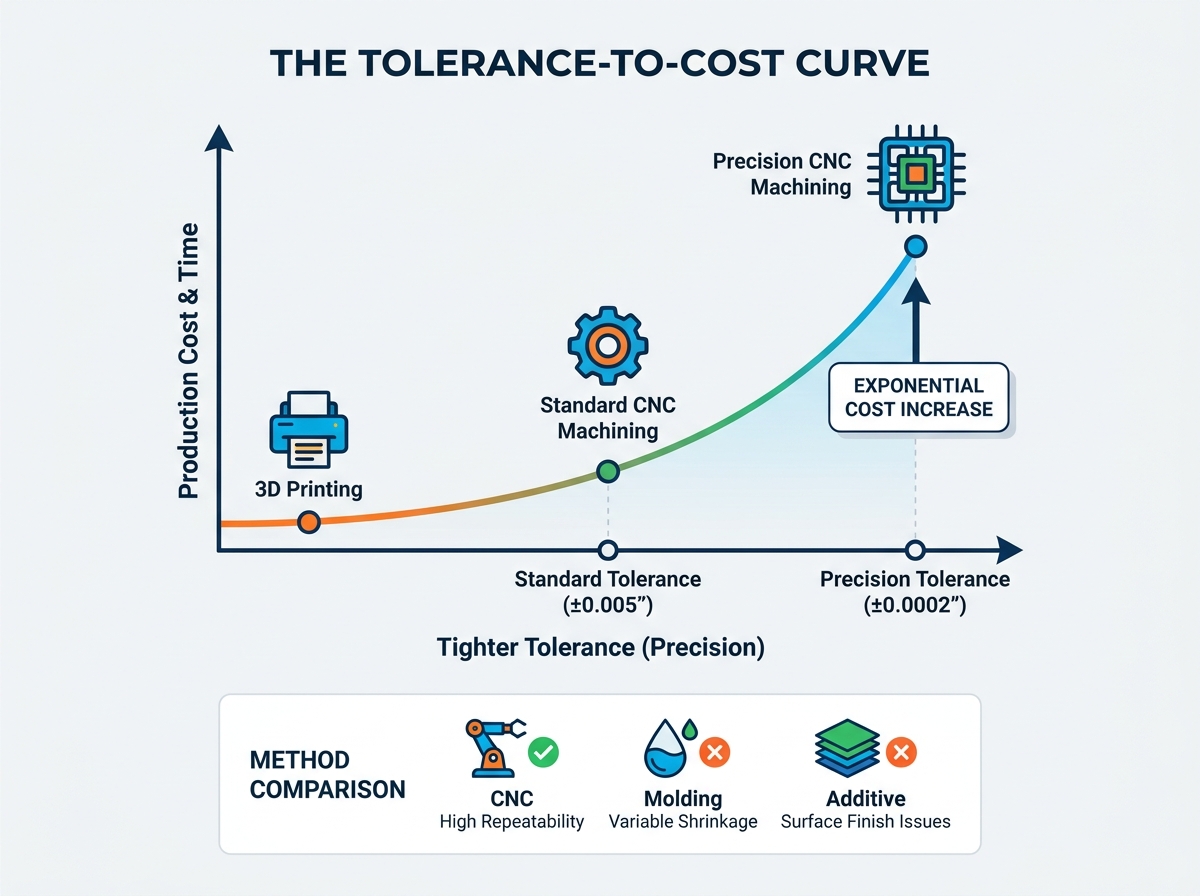
Baseline Tolerances: Standard CNC machining reliably holds tolerances of ±0.005” (0.127 mm), with precision CNC machining achieving up to ±0.0002” (0.005 mm) depending on machine rigidity and material.
Process Superiority: CNC outperforms 3D printing and casting in repeatability and surface finish, though it may be less cost-effective for complex internal geometries or low-stress prototypes.
Cost of Precision: Tighter tolerances exponentially increase machining time and cost; evaluating "acceptable" vs. "maximum" precision is critical for ROI.
Decision Matrix: Volume, material hardness, and strict compliance (e.g., aerospace AS9100) are the ultimate deciding factors between CNC and conventional methods.
Industry professionals often use the terms accuracy and repeatability interchangeably. However, they mean very different things. We must clarify this terminology to understand manufacturing capabilities. Accuracy refers to hitting an exact measurement. If a part requires a 10.00 mm width, an accurate process achieves exactly 10.00 mm. Repeatability measures consistency. It means hitting that same exact measurement across a 1,000-part run without deviation. A highly repeatable machine might consistently cut parts at 10.05 mm. It is repeatable, but not perfectly accurate. You need both to achieve true quality.
We generally separate processes into standard and precision categories. Standard operations typically follow ISO 2768 guidelines. They easily maintain general tolerances around ±0.005 inches. This works well for brackets, enclosures, and non-critical components. However, Precision cnc machining goes much further. This advanced approach utilizes multi-axis capabilities. It relies on strict environmental climate controls and high-end carbide tooling. These setups can achieve microscopic tolerances down to ±0.0002 inches. Aerospace and medical sectors heavily rely on this advanced tier.
You must also understand the tolerance-to-cost curve. This concept is critical for budget management. Demanding a ±0.0005-inch tolerance when ±0.005 inches is sufficient creates massive inefficiencies. Tighter tolerances unnecessarily spike cycle times. They require slower feed rates and frequent tool changes. Furthermore, they drastically increase your quality control rejection rates. Only pay for microscopic precision when part functionality truly demands it.
Evaluating manufacturing methods requires an objective framework. We must look at dimensional accuracy, material limitations, and scalability. Every process has inherent strengths and specific weaknesses. Understanding these boundaries helps you make smarter engineering decisions.
Manufacturing Process Comparison Matrix
Manufacturing Method | Typical Tolerance Range | Ideal Production Volume | Primary Material Focus |
|---|---|---|---|
Standard CNC | ±0.005" to ±0.001" | 1 to 10,000+ | Metals, Hard Plastics |
Manual Machining | ±0.005" to ±0.010" | 1 to 50 | Metals, Plastics |
3D Printing (FDM/SLA) | ±0.005" to ±0.020" | 1 to 100 | Resins, Thermoplastics |
Injection Molding | ±0.002" to ±0.010" | 10,000+ | Thermoplastics |
Casting & Forging | ±0.010" to ±0.050" | 1,000+ | Metals |
The precision gap between these two methods is vast. Computer-controlled equipment completely eliminates operator fatigue. It also removes the micro-inconsistencies found in human movement. A manual machinist might hold tight tolerances on a single prototype. However, they cannot replicate that perfection across 500 units. Programmed automated equipment executes identical tool paths every single time. Therefore, automated subtractive methods are best for mid-to-high volume runs. Repeatability becomes absolutely non-negotiable at these higher volumes.
These technologies serve very different engineering needs. The precision gap mostly centers on structural integrity and thermal dynamics. Subtractive methods offer superior structural strength. They provide significantly tighter tolerances, especially when cutting metals. Additive manufacturing frequently struggles with thermal warping as layers cool. 3D printed parts also exhibit stair-stepping surface finishes. These textures often require heavy post-processing. Use subtractive techniques for functional, load-bearing parts. Reserve 3D printing for rapid prototyping or parts needing complex internal lattices.
These two powerhouses dominate modern manufacturing. The precision gap here depends largely on volume and material. Subtractive cutting is highly precise for low-to-mid volumes. It handles metals and plastics effortlessly. Injection molding struggles with shrinkage. It also faces warping variables as molten plastic cools. However, molding easily wins on massive scale. You should choose automated cutting for metal components and low-volume plastics. Shift to injection molding when you need 10,000 or more plastic units.
Heavy industries rely heavily on casting and forging. The precision gap relates to final dimensions. Casting achieves excellent near-net shapes. It effectively reduces raw material waste. However, cast parts almost always require secondary post-processing for critical dimensions. The shrinkage rates of cooling metals are difficult to predict perfectly. This creates a powerful synergy between the methods. You will frequently see CNC Machining serving as the essential secondary operation. It finishes rough cast parts to meet demanding, tight engineering tolerances.
Many people assume computers guarantee perfect parts. The reality is far more complex. Several fundamental engineering variables dictate the actual precision you receive.
Machine rigidity and build quality are critical. Vibration destroys tolerances. Engineers call this vibration "chatter". When a cutting tool engages tough metal, it generates immense forces. Lighter machines bend and vibrate under this stress. This movement ruins the surface finish and part dimensions. Heavier, cast-iron machine beds absorb these vibrations. They yield much higher precision. A rigid foundation is non-negotiable for sub-micron accuracy.
Thermal compensation also plays a massive role. Thermal drift is a hidden enemy in manufacturing. Aggressive cutting generates substantial friction and heat. This heat transfers into the machine spindle and the part itself. As metal heats up, it expands. A part machined perfectly at 100 degrees will shrink when it cools to room temperature. High-end machines feature advanced thermal auto-compensation. They use sensors to monitor heat and adjust tool offsets dynamically in real-time.
Spindle quality and servo motors drive the physical action. These mechanical components execute the microscopic movements commanded by the software. Standard motors have a margin of error when positioning axes. High-end linear scales and servo motors offer superior axis control. They can position a tool within fractions of a micron. The engineering reality is simple. The software is only as precise as the physical hardware moving the cutter.
Tool wear and calibration directly impact production runs. Tool deflection happens when a long end mill pushes against hard material. The tool physically bends away from the cut. Furthermore, tools degrade over a long production run. A sharp cutter might hit 10.00 mm on part number one. By part number 500, the dulled cutter might leave 10.05 mm of material. Shops use frequent probing routines to counter this. They measure tool lengths automatically and adjust machine offsets to maintain strict repeatability.
The manufacturing industry holds many misconceptions about subtractive processes. We must separate myth from reality to optimize production strategies. Blindly defaulting to one method often leads to project failures.
Consider the most common myth. Many believe computer-controlled cutting is always the most accurate method for any geometry. The reality tells a different story. Electrical Discharge Machining (EDM) often outperforms standard cutting tools. EDM can hold much tighter tolerances on specific hardened metals. It also excels at extremely intricate internal profiles. If a profile requires a sharp internal corner, standard round cutting tools will fail. They simply cannot cut a perfect 90-degree internal angle without deflecting or breaking.
Another dangerous myth is assuming maximum precision means maximum part quality. Engineers frequently fall into this trap. The reality is that over-engineering tolerances wastes massive amounts of budget. Applying a ±0.0005-inch requirement to cosmetic surfaces or standard clearance holes serves no functional purpose. True success lies in strategic application. You must apply Geometric Dimensioning and Tolerancing (GD&T) principles carefully. Only assign tight tolerances to critical mating surfaces or bearing fits.
You also face significant implementation risks regarding material selection. A major risk is failing to align the CAD model’s required tolerances with the chosen material’s machinability. For example, some engineers try to hold ±0.0002 inches on soft plastics like Teflon or UHMW. This is practically impossible. Soft plastics deform heavily under cutting pressure. They also expand and contract drastically with minor temperature shifts. You must match your tolerance expectations to your material's physical limitations.
Selecting the right production process requires an actionable evaluation framework. You can use this simple decision matrix to guide your team.
Evaluate Part Functionality: Analyze the end-use environment. Is the component load-bearing? Will it experience high friction or thermal stress? If yes, this heavily points toward subtractive cutting of solid metals or high-performance polymers.
Analyze Required Tolerances: Look closely at your assembly requirements. Does the part require sub-micron precision for a press fit? This points directly to high-end precision centers or EDM processes. Standard 3D printing cannot achieve this.
Determine Production Volume: Volume dictates the economics. If you need 5 prototypes, print or machine them. If you need 5,000 units, consider injection molding or casting followed by secondary finishing.
Compliance and authoritativeness also drive decision-making. Certain industries require strict, documented audit trails. Medical device manufacturers must adhere to ISO 13485 standards. Aerospace components must meet strict AS9100 requirements. Subtractive machining provides highly predictable, documented material properties. The raw metal blocks come with material certifications. Additive methods melt and reform materials, which changes their internal molecular structure. This makes regulatory compliance much harder for 3D printed end-use parts.
Finally, understand what to prepare before shortlisting partners. Buyers must organize specific assets before requesting a quote. You should prepare fully annotated 2D drawings. Ensure your 3D CAD models are clean and finalized. Most importantly, clearly define all critical-to-quality (CTQ) features. Highlight exactly which dimensions actually matter for the part to function. This preparation allows engineers to provide accurate pricing and realistic lead times.
Subtractive manufacturing clearly remains the global gold standard for repeatable precision. It reliably bridges the difficult gap between rapid prototyping and mass-production molding. While 3D printing excels at speed and molding dominates volume, programmed cutting delivers unparalleled dimensional accuracy across solid, structural materials. You achieve robust parts capable of passing strict aerospace and medical audits.
Take action on your next project today. Evaluate your current CAD designs against the variables discussed above. Identify your critical mating surfaces and optimize your GD&T callouts to save time and budget. Upload your CAD files or contact an engineering team for a comprehensive Design for Manufacturability (DFM) review. A precise tolerance assessment will ensure you specify the exact right method for your unique project.
A: The standard industry tolerance for general manufacturing typically follows ISO 2768 guidelines. Most reputable shops reliably hold ±0.005 inches (0.127 mm) on standard equipment. However, advanced precision setups can achieve tolerances as tight as ±0.0002 inches (0.005 mm) depending on the material and part geometry.
A: Tighter tolerances require significantly more machine time. Operators must use much slower feed rates to prevent tool deflection. They also require frequent tool changes as cutters dull quickly. Furthermore, microscopic tolerances increase the risk of part rejection, leading to higher scrap rates that increase overall project expenses.
A: No. Plastics present unique challenges. They suffer from material deformation under cutting pressure. Furthermore, heat buildup during cutting causes plastics to expand dynamically. Once the part cools, it shrinks, altering final dimensions. Relieving internal material stresses is much harder in plastics compared to rigid metals like aluminum or steel.
A: Yes, primarily because it reduces setup changes. A 3-axis machine often requires an operator to manually flip a part to reach different sides. Each manual flip introduces slight alignment variations, known as stacking errors. A 5-axis machine accesses five sides of a part in a single setup, virtually eliminating these stacking errors.


