


Views: 0 Author: Site Editor Publish Time: 2026-07-31 Origin: Site


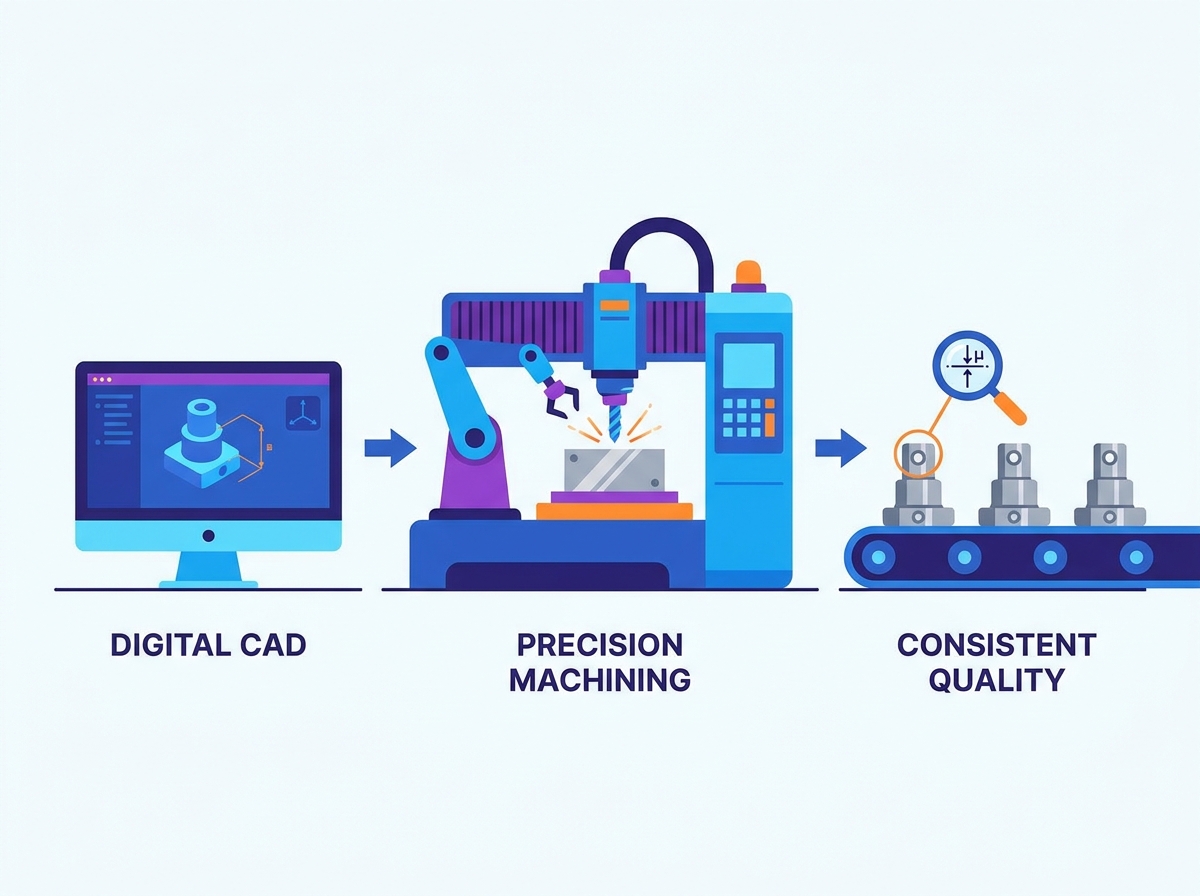
Engineering and procurement teams face a critical pivot point every day. You must transition complex designs from digital CAD to physical reality. Doing this correctly means never compromising structural integrity. It also means protecting your overall project budget. Teams frequently struggle to balance these strict requirements during product development cycles.
Traditional manual methods often introduce human error and minor inconsistencies. Operators experience physical fatigue over long shifts. Additive manufacturing offers unique geometries but sometimes struggles to match required mechanical properties. Printed parts frequently exhibit layer adhesion weaknesses. Modern automated machining fills this gap perfectly. It provides unmatched reliability, raw material strength, and strict dimensional accuracy.
Evaluating the technical and commercial viability of precision manufacturing heavily impacts your total engineering outcomes. It directly influences strict regulatory compliance across global markets. It also speeds up your critical time-to-market metrics. Understanding these specific benefits helps you make confident sourcing decisions. You can streamline your supply chain and launch superior products faster.
Unmatched Repeatability: CNC systems eliminate manual variance, ensuring identical specifications across low- to mid-volume production runs.
Tight Tolerance Thresholds: Capable of maintaining micro-level tolerances (often ±0.0005 inches or tighter) critical for aerospace, medical, and automotive compliance.
Material Unrestricted: Processes a vast array of high-performance materials, from aerospace-grade titanium to advanced engineering plastics, without altering baseline material properties.
Favorable ROI for Mid-Volume: While setup costs exist, the automation and speed drastically lower the per-part cost compared to traditional manual machining.
High-stakes industries face severe financial penalties for poor manufacturing quality. The cost of poor quality climbs rapidly during critical field failures. Aerospace and medical sectors demand absolute operational perfection. A single failed component causes catastrophic physical outcomes and massive financial liabilities. You cannot afford unexpected geometric deviations. Parts must fit together flawlessly on the assembly line.
We measure production success by establishing a strict performance balance. You need rapid production speed. You also need verifiable quality control systems. Strict geometric fidelity remains absolutely non-negotiable. Missing any single factor jeopardizes the entire product launch. Engineers require predictable results every single time they hit cycle start.
CNC Machining solves these exact challenges directly. It shines brightest when part complexity, material hardness, and strict compliance intersect. Traditional methods struggle under these extreme parameters. Advanced automation removes costly guesswork from your production line. It transforms digital models into reliable physical assets.
Manual turning operations rely heavily on human skill and physical endurance. Operators naturally experience fatigue during extended production runs. Software-driven accuracy replaces this inherent human variance entirely. Computer codes guide heavy cutting tools along exact mathematically defined paths. They execute micro-movements flawlessly thousands of times per hour.
This automated method easily handles highly complex geometric shapes. Manual milling becomes economically unviable for intricate curved designs. Advanced Precision cnc machining achieves features completely impossible for human hands alone. It easily carves out deep pockets, intricate sweeping curves, and complex threading. You achieve exact dimensional matches to your original CAD files.
We refer to this workflow as the "program once, produce infinitely" paradigm. Once you lock in the optimized CAM programming, total consistency follows. Automated tool paths guarantee strict uniformity across massive batch sizes. The thousandth part performs identically to the very first prototype.
You effectively eliminate random variations between different factory production shifts. An evening shift produces the exact same quality as a morning shift. This automated repeatability dramatically reduces your final inspection bottlenecks. It builds deep confidence in your broader supply chain operations.
Reduced human intervention significantly accelerates your daily production schedules. Automated machines run continuously in modern lights-out manufacturing setups. They do not require shift changes or rest breaks. Tool changers swap cutting bits automatically in mere seconds.
Scrap rates plummet drastically compared to older manual machining techniques. Rework costs virtually disappear from your financial ledgers. High-speed spindles remove tough material much faster than legacy equipment. You receive your finished components in days instead of several weeks. Faster cycle times directly translate into lower per-part pricing.
Broad compatibility defines modern subtractive manufacturing processes. We routinely cut difficult-to-machine superalloys daily. Inconel, aerospace-grade titanium, and hardened stainless steel pose no major operational issues. High-performance engineering polymers also perform beautifully under these cutting bits. You can easily process resilient plastics like PEEK and Ultem resins.
Subtractive processes preserve structural material integrity perfectly. Additive 3D printing often introduces internal layer adhesion weaknesses. Printing melts materials and restructures their foundational bonds. By contrast, milling from a solid billet maintains original isotropic properties entirely. The base material retains its complete original structural strength. The finished part handles stress equally well in every direction.
Compliance strictly requires these highly verifiable engineering outcomes. Medical implants face demanding FDA regulatory requirements. Aerospace components must meet strict FAA safety regulations continuously. Exceptional machining precision directly supports these strict regulatory demands. You know exactly how the metal will behave under extreme physical stress.
Material Properties Comparison
Material Category | Example Materials | Key Properties Maintained | Common Target Industries |
|---|---|---|---|
Hard Metals | Titanium, Inconel | High heat resistance, maximum tensile strength | Aerospace, Energy |
Standard Metals | Aluminum 6061, Stainless 304 | Excellent strength-to-weight ratio, corrosion resistance | Automotive, Consumer Goods |
High-Temp Polymers | PEEK, Ultem | Chemical resistance, electrical insulation | Medical Devices, Electronics |
Standard Plastics | Delrin, Polycarbonate | High machinability, impact resistance | Prototyping, Industrial Tooling |
Agile iteration heavily depends on highly consistent manufacturing methods. You use the exact same process for initial prototypes and final parts. This eliminates painful translation errors during design-for-manufacturing phases. You test the actual end-use material properties extremely early. Engineers avoid redesigning parts just to suit a different mass-production method later.
The cost-volume curve strictly dictates your best financial strategy. Setup costs amortize very quickly over medium-sized production runs. Injection molding certainly dominates massive scaling operations above 100,000 units. However, subtractive methods offer superior ROI for lower product volumes. Prototyping and mid-volume runs between 10 and 10,000 parts benefit most.
You entirely avoid massive upfront injection mold tooling costs. High-quality steel molds frequently cost tens of thousands of dollars. CNC Machining skips this hurdle entirely. Your cost per part remains highly competitive without requiring massive capital risks. You can modify the digital design instantly between small production batches.
Complete transparency builds vital trust in any manufacturing partnership. We must objectively acknowledge specific process constraints. Understanding these limitations helps you design better, more cost-effective products.
Upfront setup routines require initial financial investments. CAM programming demands highly skilled engineering labor. Custom work-holding fixtures demand dedicated design time. Machine preparation happens before any actual metal cutting starts. You pay for this setup time regardless of your final part volume.
Geometric constraints dictate several important design rules. Subtractive tools use rapidly rotating cylindrical cutting bits. Sharp internal corners require special adaptations or entirely secondary operations. Deep internal cavities severely limit physical tool access. Complex undercuts require highly specialized cutting tools. These factors increase setup times and inflate final costs.
Material waste remains an inherent reality of subtractive manufacturing. Removing material naturally generates scrap chips. This waste heavily affects pricing when cutting highly expensive alloys like titanium. We strongly recommend optimizing your billet sizes carefully.
Common Mistakes to Avoid in Part Design:
Designing perfectly sharp internal right angles lacking corner radii.
Specifying extremely thin walls highly prone to machining vibration.
Creating deep vertical pockets exceeding standard tool length ratios.
Adding purely cosmetic complex undercuts requiring highly specialized tooling.
Applying tight micro-tolerances to non-critical external cosmetic surfaces.
Selecting the right production partner strictly secures your overall project success. A bad choice leads to missed deadlines and blown budgets.
Machine capability analysis drives your very first sourcing decision. Simple flat parts only need standard 3-axis milling machines. Highly complex geometries require advanced continuous 5-axis centers. Mill-turn machines expertly handle cylindrical parts featuring complex off-axis cuts. You must match the vendor's equipment directly to your specific part complexity.
Quality Assurance demands strict, documented operational systems. Look for deeply integrated Quality Management Systems first. ISO 9001 or specialized AS9100 certifications prove their active commitment. In-house Coordinate Measuring Machine validation ensures absolute dimensional accuracy. Do not accept parts lacking detailed inspection reports.
Supply chain resilience keeps your critical projects on track. Vendor fragmentation frequently causes unnecessary shipping delays. A strong partner safely handles secondary operations entirely in-house. Anodizing, protective heat treating, and final assembly happen directly under one roof. This minimizes shipping risks and centralizes vendor accountability.
Best Practices for Submitting an RFQ:
Prepare perfectly clean 3D CAD models using standard STEP formats.
Include detailed 2D PDF drawings featuring precise GD&T callouts.
Specify exact material grades and any required compliance certifications.
Define critical surface finish requirements clearly using standard Ra values.
State your target production volumes and required delivery schedules upfront.
Subtractive processes remain the definitive gold standard for modern hardware development. Projects demanding uncompromising physical accuracy rely on them heavily. They deliver exceptional raw material strength and highly predictable automated scalability. By standardizing your prototype and production workflows, you significantly reduce financial risks.
Advanced Precision cnc machining adapts rapidly to changing market conditions. It bridges the gap between digital concepts and reliable physical products seamlessly. Partnering with certified manufacturing experts consistently guarantees measurable engineering success. They help you navigate complex design constraints effectively.
Take definitive action on your next engineering challenge today. Submit your complex CAD files for a comprehensive manufacturability review. Request a detailed tolerance consultation to optimize your upcoming designs. Get a direct project quote and launch your production confidently.
A: Standard baseline tolerances typically fall around ±0.005 inches. However, advanced equipment pushes these boundaries much further. High-precision projects routinely achieve tight tolerances up to ±0.0001 inches. Your final results depend heavily on the chosen material, specific machine capabilities, and part geometry. Hard metals generally hold tighter tolerances than softer engineering plastics.
A: Subtractive manufacturing delivers vastly superior structural integrity. Cutting parts from solid billets maintains isotropic material properties. Additively printed parts often exhibit directional weaknesses between printed layers. Machined components also boast excellent surface finishes directly off the mill. While additive excels at complex internal voids, traditional milling provides better unit economics for mid-volume production scaling.
A: Part complexity heavily influences final production pricing. Complex geometries requiring 5-axis setups increase machine time. Exceedingly tight tolerances demand frequent secondary inspections and careful operator handling. Processing very hard materials like Inconel accelerates cutting tool wear. Deep pockets, sharp internal corners, and intricate undercuts also require specialized programming and custom tooling.
A: Yes, it works exceptionally well for low volumes. Setup costs amortize very quickly across small runs. Modern CAM software has drastically reduced initial programming time. This effectively lowers the entry threshold for short production cycles. You completely avoid the massive upfront tooling expenses associated with injection molding. It remains highly viable for batches ranging from ten to ten thousand units.


