


Views: 0 Author: Site Editor Publish Time: 2026-10-23 Origin: Site


Advanced manufacturing is experiencing a fundamental shift today. Part complexity continues to increase rapidly across various industrial sectors. Tight tolerances now make traditional 3-axis setups a serious production bottleneck. Procurement and engineering teams face a core tension daily. You must balance the higher upfront costs of advanced machining against significant production risks. Multi-setup operations often lead to dangerous tolerance stacking. They also cause extended lead times. You need a reliable way to navigate these difficult trade-offs. We provide a pragmatic, evidence-based framework in this comprehensive guide. You will learn exactly how to determine if your specific industry application justifies the financial investment. We explore key sectors driving this advanced technology forward. You will also discover how to evaluate potential manufacturing partners effectively. Let us dive into the critical evaluation criteria you need to modernize your supply chain.
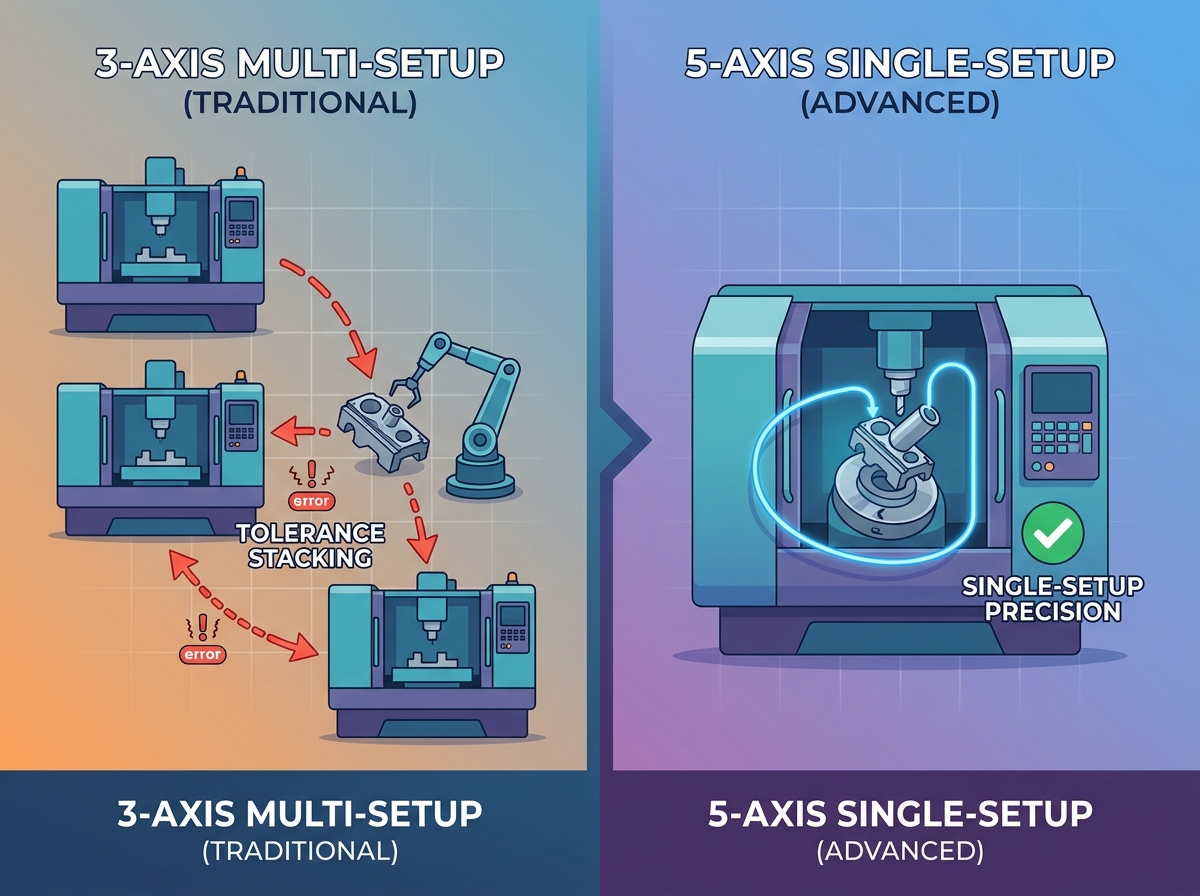
Continuous 5-axis CNC machining is most cost-effective for parts where combining multiple setups reduces tolerance stacking and manual intervention.
Aerospace, medical, and EV automotive sectors drive adoption due to strict compliance standards and complex organic geometries.
Evaluating a 5-axis service partner requires looking beyond machine specifications to assess CAM programming expertise and integrated metrology (CMM).
For prismatic parts with accessible features, 3-axis or 3+2 (positional) machining often yields a better ROI.
You must define exact trigger points before migrating a part to more advanced equipment. Upgrading becomes essential when parts require three or more manual setups. Unacceptable fixture-induced errors often ruin production batches. High scrap rates on expensive raw materials easily destroy your profit margins. You should migrate when these specific pain points emerge in your workflow.
Engineering teams must understand the technical distinctions between solution categories. You have three main options available for complex parts.
3-Axis Machining: The cutting tool moves across the X, Y, and Z linear axes. Operators must manually reposition the part to machine different sides.
3+2 Machining (Positional): The machine rotates the part to a fixed angle using two rotational axes. It locks these axes securely before cutting begins. This method drastically reduces manual setups.
Continuous 5-Axis Machining: The equipment moves all five axes simultaneously. This synchronized movement allows the cutting tool to follow complex, contoured surfaces seamlessly.
Technology Type | Setup Reduction | Simultaneous Movement | Best Application |
|---|---|---|---|
3-Axis | Low | No | Simple, flat components |
3+2 (Positional) | High | No | Prismatic parts, angled features |
Continuous 5-Axis | Very High | Yes | Organic shapes, aerospace blades |
A realistic cost-to-outcome analysis is crucial for your business case. We acknowledge the premium hourly cost associated with advanced equipment. However, return on investment (ROI) rarely comes from comparing raw machine hourly rates. You achieve true ROI through radically reduced cycle times. You eliminate expensive custom fixturing costs entirely. You also experience significantly lower scrap rates. Choosing 5-axis CNC machining is a strategic decision based on overall part economics.
The aerospace industry pushes manufacturing technology to its absolute limits. Engineers design structural airframe components requiring maximum strength and minimal weight. Turbine blades feature incredibly complex aerodynamic profiles. Complex housing units protect sensitive avionics in extreme environments. These applications demand continuous simultaneous movement to achieve precise geometries.
We evaluate success in this sector by looking at features-to-outcomes. Continuous movement allows manufacturers to create monolithic parts efficiently. They hog out complex designs from single solid blocks of titanium or aerospace-grade aluminum. This subtractive process replaces the need to assemble multiple weak sub-components. Monolithic structures offer superior structural integrity for flight-critical applications.
Compliance and security govern every decision in defense manufacturing. Suppliers must maintain strict AS9100 compliance throughout production. Material traceability remains non-negotiable for every single component. Minimizing human handling is essential to meet stringent FAA and DoD standards. Automation reduces the risk of accidental drops or handling damage.
Control Thermal Distortion: Thin-walled aerospace parts warp easily under cutting heat. Use advanced CAM simulation software to optimize tool paths.
Ensure Rigid Setups: Use specialized zero-point workholding systems. They prevent micro-vibrations during heavy material removal operations.
Verify Before Cutting: Always run digital twin simulations. A single crash on an aerospace part wastes thousands of dollars in raw material.
Medical manufacturing requires unparalleled precision. Orthopedic implants like knee and hip joints replicate natural bone structures. Surgical instruments must function flawlessly in life-or-death situations. MRI machine components require non-magnetic materials cut to exact tolerances. These specialized products depend on advanced manufacturing techniques.
Surface finish represents a critical evaluation dimension for medical parts. Simultaneous movement eliminates "scalloping" or visible step-over marks on complex organic curves. Scalloping creates microscopic ridges where harmful bacteria can hide. A perfectly smooth surface is absolutely critical for successful implant integration. It also ensures thorough sterilization between surgical procedures.
Medical engineers frequently select incredibly tough materials. They rely on work-hardening alloys like Titanium (Ti-6Al-4V) and Cobalt-Chrome. These metals resist wear and corrosion inside the human body. However, they destroy cutting tools quickly if machined improperly. Advanced tool paths maintain constant chip loads. This approach extends tool life and prevents localized heat damage to the implant.
You must consider the strict compliance context of medical manufacturing. ISO 13485 standards require total traceability and perfect repeatability. Doing this in a single setup simplifies quality control documentation significantly. Every part coming off the machine must match the validated master prototype exactly.
The electric vehicle (EV) market moves at breakneck speed. Engineers constantly redesign EV motor housings to optimize cooling efficiency. They develop lightweight suspension components to extend battery range. Rapid prototyping of complex engine block features helps traditional automotive companies transition smoothly. All these applications require highly agile manufacturing methods.
Scalability and shortened lead times drive adoption in this sector. Integrating 5-axis CNC machining accelerates your R&D phase dramatically. You can achieve rapid iteration of complex parts in days. You no longer wait months for expensive custom molds or multi-stage fixtures. This speed provides a massive competitive advantage.
The primary decision focus involves transitioning from low-volume prototypes to optimized production runs. Automotive teams must balance aggressive weight reduction against critical structural integrity. Multi-axis capabilities allow engineers to remove excess material from hard-to-reach pockets. This process, known as lightweighting, improves vehicle performance without sacrificing passenger safety.
Designing impossible features: Engineers sometimes design internal cavities impossible to reach, even utilizing continuous movement.
Ignoring production scalability: Machining a single prototype is easy. You must ensure the chosen tool paths translate well to high-volume production cells.
Over-tolerancing non-critical areas: Specifying ultra-tight tolerances on cosmetic surfaces needlessly inflates cycle times and prototyping costs.
Energy sector equipment operates in the harshest environments on Earth. Manufacturers produce massive impellers and high-speed rotors for power generation. Deep-sea drill bits crush solid rock daily. High-pressure fluid control valves manage explosive gases safely. Failure in these components leads to catastrophic environmental disasters.
Durability dictates material choices in oil and gas applications. You must focus on machining superalloys like Inconel, Monel, and Super Duplex stainless steels. These materials resist extreme corrosion and high temperatures easily. Unfortunately, they are notoriously difficult to cut. They generate immense heat and cutting forces during the manufacturing process.
Technical benefits emerge clearly when cutting superalloys on advanced machines. You can utilize unique tool orientations effectively. Tilting the spindle allows you to use much shorter, more rigid cutting tools. Long tools bend and vibrate easily during heavy cuts. This vibration, known as chatter, ruins surface finishes and shatters expensive carbide end mills. Shorter tools reduce chatter significantly. They extend tool life and maintain tight tolerances when machining heavy-duty alloys.
Finding a capable manufacturing partner requires intense scrutiny. You need a rigid vendor selection framework. Procurement and engineering teams must look far beyond the shiny machine brand sitting on the shop floor. The surrounding ecosystem of software, quality control, and human talent matters much more.
Evaluate your potential partners using these specific dimensions:
CAM and Programming Expertise: The best machine is only as good as its programmer. Ask about their software stack. Look for advanced simulation capabilities like Vericut. These programs simulate real-world physics to prevent disastrous machine crashes.
Quality Assurance Integration: Precision machining requires strict environmental controls. Verify their facility uses climate-controlled production floors. Check for in-machine probing routines. Ensure they link their processes to high-accuracy Coordinate Measuring Machines (CMMs) for final validation.
Capacity and Redundancy: Hardware breaks down eventually. Does the vendor operate backup machines? Single-point-of-failure delays can derail your entire product launch schedule. Ensure they possess enough redundant capacity to handle unexpected downtime gracefully.
You should initiate specific next-step actions before signing a long-term contract. Always request a Design for Manufacturing (DFM) review first. Let their expert programmers analyze your CAD files for potential issues. Following a successful DFM review, initiate a small pilot run. This low-risk step validates their quality control processes before committing to full production volumes.
Advanced multi-axis manufacturing is not a universal solution for every product. It serves as a highly strategic capability designed for specific challenges. It eliminates costly setup errors reliably. It handles highly complex organic geometries effortlessly. It machines the toughest materials required by heavily regulated industries. You achieve the best results when applying this technology to aerospace, medical, automotive, and energy components.
We advise you to conduct a comprehensive cost-per-part analysis on your complex designs. You must factor in manual setup time, custom fixture costs, and expensive material scrap rates. Do not rely solely on comparing hourly machining rates. The total economic picture often heavily favors advanced automated setups for complex geometries.
Take action today to modernize your procurement strategy. Submit your complex CAD files to a qualified manufacturing partner. Request a thorough technical review and a strict tolerance capability check. Engage their engineering team for a dedicated DFM consultation to optimize your next big project.
A: No, it is not always more expensive. We acknowledge the hourly machine rates are higher. However, your total part cost can be significantly lower for complex geometries. You save money through drastically reduced manual setups. You eliminate expensive custom fixturing entirely. You also benefit from faster overall manufacturing throughput and reduced scrap rates.
A: We recommend 3+2 machining for prismatic parts featuring flat, off-angle features. Continuous contouring is unnecessary for these shapes. The 3+2 method locks the axes securely during cutting operations. It achieves excellent setup-reduction benefits at a slightly lower programming and machine cost.
A: These advanced machines handle standard metals and engineering plastics easily. They truly excel when cutting difficult materials. You can efficiently machine Inconel, Titanium, and hardened steels. The ability to tilt the spindle allows you to utilize shorter, highly stable tools for these tough superalloys.
A: It eliminates a major problem called "tolerance stacking." Machining five sides of a part in a single setup allows the machine to maintain one single zero-reference point. This brilliant approach completely removes the human error introduced every time you unclamp and re-fixture a part manually.


