


Views: 0 Author: Site Editor Publish Time: 2026-10-26 Origin: Site


Choosing between 3-axis and 5-axis CNC machining is not just a technical preference. It is a critical commercial decision. This choice heavily dictates your unit economics, project lead times, and overall quality control. Many engineering teams struggle to balance these factors. They often misalign machine capabilities with actual part complexity, which drains budgets quickly.
You need a clear, return-on-investment framework. Surface-level definitions simply do not provide enough guidance for modern manufacturing. You must evaluate the exact requirements of your components. This includes understanding geometric complexity, strict tolerance needs, and real-world budget constraints.
In this guide, we move beyond basic machine specs. We will show you exactly how to match your project to the right equipment. You will learn how to reduce manual setups, avoid unnecessary programming costs, and leverage design adjustments to maximize your manufacturing budget.
3-Axis is standard for a reason: It remains the most cost-effective solution for prismatic, single-face, or low-complexity parts.
5-Axis solves for setups, not just shapes: The primary ROI of 5-axis CNC machining often comes from eliminating manual re-fixturing, which reduces labor costs and tolerance stacking.
The "3+2" middle ground: Positional 5-axis (3+2) offers multi-sided machining capabilities without the heavy hourly rates and complex programming required for full, continuous 5-axis interpolation.
Design for Manufacturability (DFM) matters: Minor design adjustments can often allow a part intended for 5-axis to be machined on a 3-axis, significantly reducing costs.
You must understand the mechanical baselines before selecting a machining process. Each machine type offers distinct advantages. They also present unique limitations affecting production speed and precision.
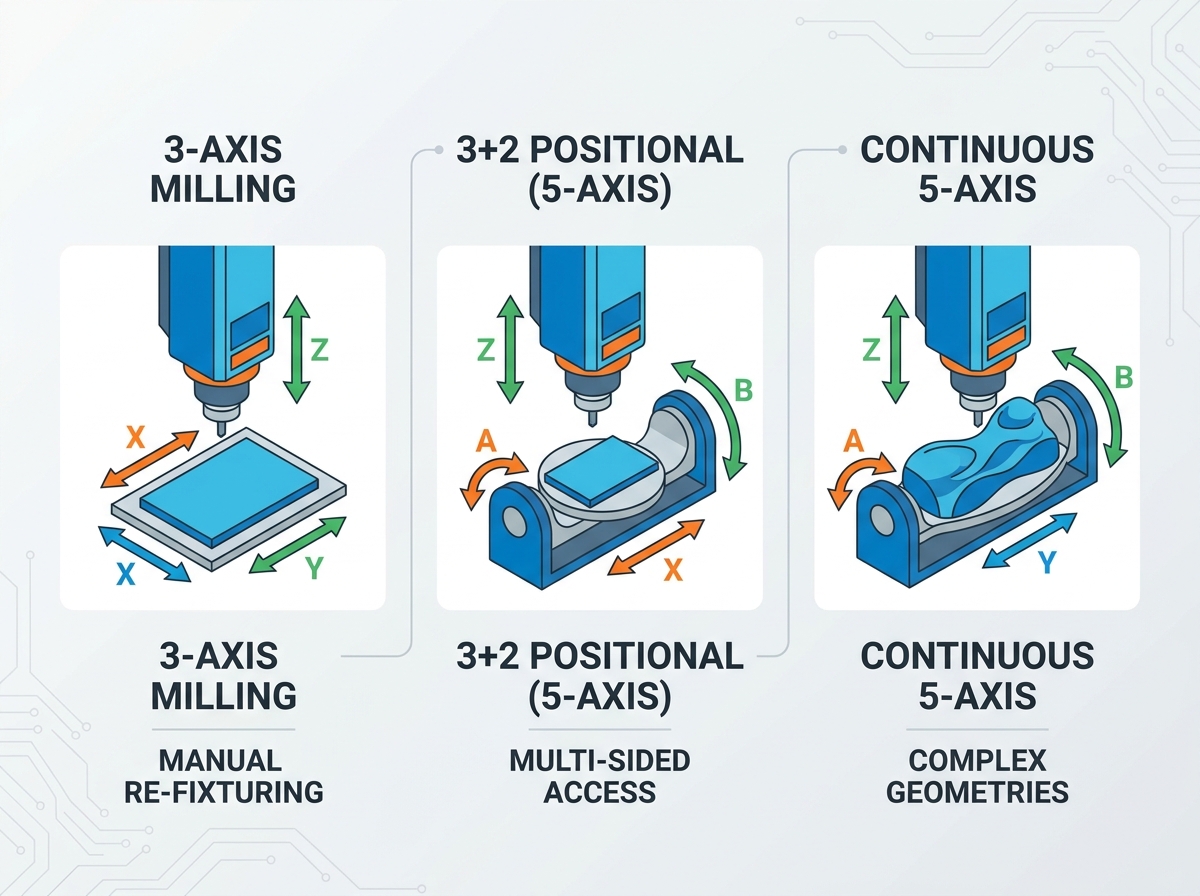
A standard 3-axis mill moves a cutting tool along three linear axes. These are the X, Y, and Z axes. The workpiece remains completely stationary during the cutting process.
Capability: This method works beautifully for flat components. It excels at cutting simple slots, profiling edges, and drilling standard holes.
Limitation: You can only machine one side of the part at a time. If your part requires machining on multiple faces, the machine must stop completely. An operator then manually unclamps, rotates, and re-clamps the part. Manufacturers call this a new "setup." Multiple setups drastically increase manual labor.
Continuous machines add two rotational axes to the standard X, Y, and Z movements. These are typically the A and B (or C) axes. Crucially, all five axes move simultaneously during the cutting cycle.
Capability: This simultaneous interpolation is essential for complex components. 5-axis CNC machining effortlessly handles organic geometries. It cuts continuous sweeping curves and accesses complex undercuts without stopping.
Common Mistake: Many buyers assume any 5-axis machine can perform continuous interpolation. Always verify with your manufacturing partner if their machine supports simultaneous movement or just positional indexing.
The 3+2 method serves as a highly efficient middle ground. The machine rotates the A and B axes to a specific fixed angle. It locks them securely in place. The cutting tool then performs standard 3-axis movements on the newly exposed face.
Capability: You gain access to five distinct sides of a part in a single setup. This method is ideal for high-precision, multi-sided prismatic parts. You avoid the extreme programming complexity required for continuous movement.
Machining decisions ultimately come down to commercial realities. You must weigh machine hourly rates against manual labor savings. A stronger machine capability often offset higher upfront costs.
We must acknowledge the upfront capital differences. Five-axis machines carry significantly higher depreciation costs. They feature complex kinematics, requiring expensive routine maintenance. Consequently, hourly machine rates are often 1.5x to 2x higher than standard 3-axis mills. You pay a premium for spindle time.
Hardware is only half the equation. Continuous 5-axis CNC machining requires advanced CAM (Computer-Aided Manufacturing) software. It also demands highly skilled programmers. Generating safe, collision-free toolpaths takes time. This increases your upfront Non-Recurring Engineering (NRE) costs significantly.
You must contrast these higher machine rates against potential labor savings. This is the crucial turning point. If a complex part requires four to six manual setups on a 3-axis machine, costs multiply rapidly.
Consider the typical steps for a manual setup:
The machine sits completely idle.
An operator unclamps the workpiece.
The operator cleans the fixture and reorients the part.
They secure new custom fixturing.
They probe the part to establish new zero points.
Manual labor costs and machine idle time explode during these transitions. Custom fixturing adds even more expense. In these scenarios, the labor savings rapidly outpace the premium hourly rate of a 5-axis machine. The "done-in-one" approach protects your margins.
Commercial savings matter, but component quality is non-negotiable. Advanced machining configurations offer massive advantages regarding final part precision. They remove human error from the equation entirely.
Every manual re-fixturing event introduces a slight alignment variance. Even highly skilled operators experience minor clamping deviations. When you move a part four times on a 3-axis machine, these small errors accumulate. Engineers call this "tolerance stacking."
A "Done-in-One" setup eliminates this risk. The machine establishes a single datum point for the entire operation. This ensures true position accuracy. It guarantees strict adherence to Geometric Dimensioning and Tolerancing (GD&T) standards across multiple faces. Features align perfectly because the part never leaves the initial fixture.
Spindle head maneuverability provides a major tooling advantage. A multi-axis spindle can orient much closer to the workpiece. This closer proximity yields substantial benefits:
Shorter Tools: You can use shorter, far more rigid cutting tools.
Reduced Vibration: Shorter tools drastically reduce vibration, commonly known as chatter.
Higher Feed Rates: Increased rigidity allows programmers to safely increase cutting speeds.
Superior Surface Finish: Smooth cutting action yields exceptional surface finishes. You often eliminate the need for secondary manual polishing entirely.
Certain industries cannot compromise on geometry or precision. In these sectors, advanced multi-axis capabilities move from an optional luxury to a strict requirement.
Aerospace components demand extreme aerodynamic efficiency. You will frequently encounter jet engine impellers, turbine blades, and contoured structural blisks. These parts rely on continuous sweeping toolpaths. A standard 3-axis mill physically cannot access the necessary angles without destroying the blade geometry.
The medical field relies heavily on organic, anatomical shapes. Orthopedic implants, such as titanium knee replacements and hip joints, require perfectly smooth transitions. You cannot achieve these biomimetic contours using planar 3-axis cuts. 5-axis CNC machining is mandatory to match the human body's complex geometry.
Sometimes, speed-to-market trumps baseline unit costs. In high-stakes prototyping, engineering teams need immediate design validation. Sequencing a complex part across a week of multiple 3-axis setups causes massive delays. A multi-axis machine can mill that same complex prototype in a single day. The rapid feedback loop justifies the premium hourly rate.
You need a systematic approach to choose the right process. Use the following framework to evaluate your specific CAD model against available machining options.
Look closely at your 3D model. Does it feature deep cavities, complex undercuts, or organic sweeping curves? If so, the geometry points directly to multi-axis equipment. A 3-axis mill cannot reach behind overhanging features.
Analyze how many times an operator must flip the part. Will the component require more than three distinct manual setups on a standard mill? If yes, you should immediately request quotes for both 3+2 and continuous 5-axis routing. Compare the total cost. The setup consolidation often wins.
Production volume shifts the math entirely. For low-volume, low-complexity prototypes, heavy multi-axis programming time might not pay off. However, for higher production volumes, the calculus changes. The dramatic reduction in physical cycle time and operator intervention makes multi-axis machines highly scalable.
Always review your design for manufacturability (DFM). Ask your engineers if they can simplify the design. Can you standardize internal corner radii? Can you eliminate a non-critical undercut? Minor design changes can often make 3-axis milling viable. This saves immense amounts of capital.
Feature | 3-Axis Milling | 3+2 Positional | Full 5-Axis Continuous |
|---|---|---|---|
Best For | Flat, simple parts | Multi-sided prismatic parts | Organic shapes, impellers |
Setup Frequency | High (manual flips required) | Low (up to 5 sides at once) | Very Low (Done-in-One) |
Programming Cost | Low | Medium | High |
Hourly Rate | Lowest | Moderate | Highest |
Your machining choice defines your project's success. Standard 3-axis milling remains the undisputed champion of cost-efficiency for simple, flat parts. You should use it whenever geometry allows. However, 5-axis CNC machining stands as an essential investment when you face complex organic shapes, strict multi-face tolerances, and excessive manual setups.
Take proactive steps on your next project:
Advise your procurement and engineering teams to demand DFM feedback alongside initial quotes.
Identify parts currently requiring four or more setups and evaluate them for multi-axis consolidation.
Submit your native CAD files to manufacturing partners to run direct cost comparisons between 3-axis and multi-axis toolpaths.
Question non-critical undercuts during the design phase to keep manufacturing costs low.
A: Yes, they absolutely can. However, it is rarely cost-effective. You tie up a highly expensive asset for simple planar work. You pay premium hourly rates for basic cuts. You should only route standard 3-axis work to a 5-axis machine if shop floor capacity strictly dictates it.
A: A 4-axis machine introduces one rotational axis. This is typically an A-axis acting as a rotary table or tombstone. It is perfect for cylindrical parts or machining around a single axis. A 5-axis machine adds a second rotational axis. This grants the cutting tool full spherical reach around the workpiece.
A: Physical cutting time and manual handling time are significantly faster due to single-setup machining. You eliminate manual part flipping. However, the initial CAM programming and software simulation phase takes much longer than standard 3-axis programming. It favors overall speed only after programming finishes.


